Blog Post
Just Another Runner on the Team
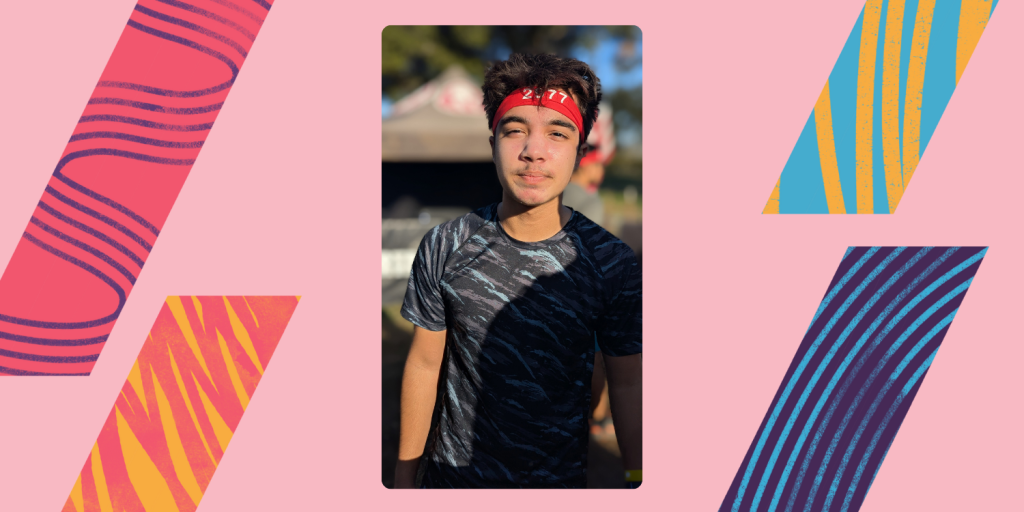
Jay is a 15-year-old transgender, Indian-American activist from the Bay Area, California and a member of the Fall/Winter 2025 class of It Gets Better’s Youth Voices ambassadors.
I didn’t start running because I wanted medals.
I started running because I wanted to feel like I belonged somewhere.
When I first joined cross country, I didn’t really know what to expect. In my head, I had a vague picture of myself running alone on long trails in the blistering sun, but instead, what I found was a community. Running with someone for hours forges the sort of bond that can’t be replicated. The friends I made in cross country would cheer me on even when I finished last, noticed when I wasn’t there, and made a running joke of complaining about the brutal workouts our coaches had planned for us.
For the first time in high school, I felt like I wasn’t “the trans kid,” but just Jay, another runner on the team.
For the first time in high school, I felt like I wasn’t “the trans kid,” but just Jay, another runner on the team.

That feeling changed everything. School started to feel safer, like something I could actually look forward to. I’d stick around after school with my teammates, laughing and talking until the sun started to set.
And I wish every trans kid could have that.
The truth is, most don’t. While 68% of cisgender kids play sports, just 13% of trans kids do the same. It’s not because we’re inherently unathletic or we hate exercise. It’s because when our only option is to play for the team of the opposite gender, most of us just decide to give up on sports entirely.
If there had been a trans sports ban in my state, I wouldn’t have been allowed to run with the boys’ team. But playing on the girls’ team was never really an option either. Doing that would’ve meant cementing other people’s ideas that I was pretending. It would’ve felt like agreeing with them that I was faking who I was. It would’ve, in a sense, meant invalidating my transness from day one. Faced with that choice, I would’ve just decided to give up sports entirely.
Faced with that choice, I would’ve just decided to give up sports entirely.
And for some trans kids who transitioned but don’t feel safe publicly sharing that they’re trans, being forced to play on a team that doesn’t match who they are isn’t just uncomfortable, it’s dangerous. It outs them to everyone watching and everyone playing. And in many schools, outed trans kids can face bullying, harassment, or worse.
Let’s do the math for a second: trans people make up 1.6% of the population, and 13% of us play sports. That means in a high school of 1000 students, theoretically just 2 student athletes could be trans, and just 1 could be a trans girl.
Excluding 1 in a thousand kids from sports just to preserve a false sense of fairness will never make sense, and it completely misses the point of high school sports in the first place. For the vast majority of high school student-athletes, playing sports isn’t about gaining a million awards and setting up a career as a professional athlete. It’s about spending time with friends, learning the value of teamwork and discipline, and having some fun playing the sport we love

Trans sports bans don’t protect anyone, but their impact on trans kids’ lives is enormous.
Trans sports bans don’t protect anyone, but their impact on trans kids’ lives is enormous. Sports helped me find a social community, but they also significantly reduce the risk of stress, anxiety, and depression, all things trans kids are already at a higher risk for.
For me, running became my safe space. For others, it could be basketball, or swimming, or soccer. In the end, it’s not about the sport itself, it’s about finding a community where you’ll never feel alone.
No matter the sport, every kid should have the chance to play.
No matter the sport, every kid should have the chance to play.