Blog Post
Meet Jumata Emill, Author of “I Don’t Wish You Well”
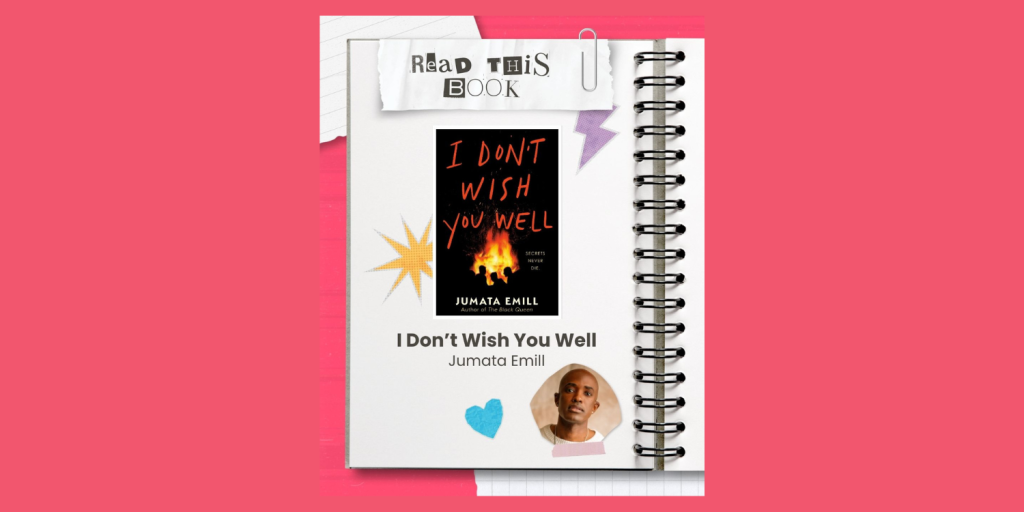
Learn more about the Summer Reading Challenge and click here to learn more about this year’s featured books.
We didn’t have a Kelly Clarkson lyric inspiring a queer YA thriller about a true-crime podcast on our bingo card, but honestly, we should have known better.
Jumata Emill’s I Don’t Wish You Well follows aspiring journalist Pryce Cummings as he returns to his Louisiana hometown to investigate a string of murders that may not have been solved after all. The deeper he digs, the more he uncovers about the homophobia, racism, and corruption his community would rather leave buried. He gets into how one lyric sparked the entire book, why he put two queer Black boys at the center of the mystery, and what it means to write the stories he needed but couldn’t find growing up.
What was the moment, person, or question that inspired you to write this story?
I was working out at the gym one evening, and jamming along to my playlist when Kelly Clarkson’s “Never Again” came on. There’s a part in the song where Kelly sings, “I would never wish bad things, but I don’t wish you well.” I paused mid bicep curl and thought, “Oh my god! That would make a great title for a book!” When I got home, I started jotting down ideas on what a book with that title could be about and out of those notes, the story was born.
If you could leave one note inside every copy of your book for the next LGBTQ+ young person who reads it, what would it say? I did already! In this book’s dedication. It reads, “This one is for all the queer Black boys who just wanted to BE but were told they couldn’t.”
What are three books other than your own centering LGBTQ+ characters that you think every person should read? Giovanni’s Room by James Baldwin is a more “classic” title I loved, Anger is a Gift by Mark Oshiro, and The Seven Husbands Of Evelyn Hugo by Taylor Jenkins Reid–don’t let the title fool you. 🙂
True crime is a genre where queer people are so often the victims of violence, with no one to tell our story or care about our humanity. Do you feel like I Don’t Wish You Well subverted any expectations of the genre? What did you consider when writing a queer YA true crime book?
I hope it does! I mean, I don’t know many books in the genre that feature not one, but TWO queer sleuths. Black male ones at that. I try not to go into writing any book with a certain “agenda” but it definitely is always at the forefront of my mind–crafting a story I wanted as a young person but just couldn’t find on bookshelves. So often queer characters are pigeonholed into certain roles in stories, but in IDWYW, you have two queer Black boys front and center, taking on a mystery that forces them comfort homophobia, racism, corrupt systems and other heavy social topics that rock their small town. Just by them having the courage and strength to do that subverts expectations because people tend to inaccurately view gay boys as weak or passive. We’re more than victims. We can be the heroes too!
Your rich career as a journalist clearly informed the book. What do you want young queer people to know about pursuing a field similar to yours and Pryce’s, particularly in telling the stories of their own communities?
That our voices are needed in those spaces. You would think in journalism internal biases and bigotry wouldn’t be an issue, but trust me, it is. The profession is dominated by a lot of people, mostly straight and white, who are so often on the right side of history that they’ve fooled themselves into thinking they could never be racist or homophobic. And because of that, they have blinders on that does influence how they approach and cover certain topics. I often had to speak up in the newsrooms I worked in to call out the issues that existed in our coverage, and when I did, those in power often listened. There just isn’t enough of us in the field doing it.
If anything, what do you hope LGBTQ+ youth, particularly Black LGBTQ+ youth, take away from this story or your own experience?
That there is a space, and a profound need, for them to exist in this world. You don’t have to be what other folks say you should be. And that there’s strength in standing tall in your truth.